EVENTS AS ANOTHER SOURCE OF ACCOUNT CONTEXT
The room is part of the record
Which events matter for your accounts, when their leadership is speaking, what was said in the room, and where it lands: on the account.
Public documents are one half of what a utility will tell you. The other half is said out loud, on panels, in hallways, at WEFTEC and state shows, by the people who run the accounts you care about.
Most vendors treat that as a trip, not as context. Badge scans. Cards. A notebook that dies on Monday. The useful sentence never lands next to the minutes and the CIP on the account.
AquaIntel treats events as another source of context: which gatherings matter for your target accounts, when their leadership is speaking, what was said in the room, and a sync into the company context graph so the insight sits with everything else you already know.
You already buy the badges. The trip should update what the company knows.
BD, sales, and marketing teams at OEMs and engineering firms that spend real money at WEFTEC, AWWA, state shows, and regional water events, and need the trip to update the account, not just fill a CRM with scans.
Built for
- WEFTEC
- AWWA ACE
- State sections
- Regional water events
Not for
- Event organizers selling sponsorship as the product
- A generic conference note app with no account graph behind it
The job, as it exists today
The offline half of the year is a black hole.
Before the show
A list of “important” events and hope the right people appear.
At the show
Voice of the utility, constraints, timing, who shapes the spec, captured as memory or a notes app that never reaches the account owner.
After the show
Scans without context. The person who heard it is on a plane.
Reading the public record at scale was already hard. Losing the offline half is the same failure in a different room. Effort does not scale across a season of events.
You need the same system that holds the minutes to hold what was said live.
WHAT THE WORKFLOW DOES
Not a note app. Context that lands on the account.
-
Surfaces the events that matter
For your territory and your target accounts.
-
Alerts when leadership from those accounts is speaking
A panel, a keynote, a session. From public event materials.
-
Captures voice-of-utility notes in the moment
What they said, about which program, asset, or constraint.
-
Turns notes into account-shaped context and next steps
Not a transcript dump.
-
Syncs into the company context graph
Beside the public-record signal on that same account.
What lands on the desk
The offline half of the year stops being a black hole.
What was said on the panel sits next to the minutes and the CIP on the same account.
TWO HALVES OF ONE ACCOUNT
Illustrative utility-
Board minutes · March, the published half
PFAS treatment alternatives study accepted. Procurement path to be determined.
-
Event program · WEFTEC, Tuesday 2:10 pm
Panel: PFAS procurement. Speaker: Utilities Director, one of your target accounts.
-
In-room note · Tuesday, the spoken half
Leaning design-build. Consultant selection in Q1. Worried about resin disposal cost.
One account, one graph
- Account
- Mid-size surface-water utility, PFAS upgrade forming
- Published half
- Study accepted in March. Procurement path open.
- Spoken half
- Design-build, consultant chosen in Q1. Resin disposal is the worry.
- What changed
- The consultant shortlist is the window, not the RFP.
- Next step
- Brief the rep before the shortlist. Reference resin disposal in the follow-up.
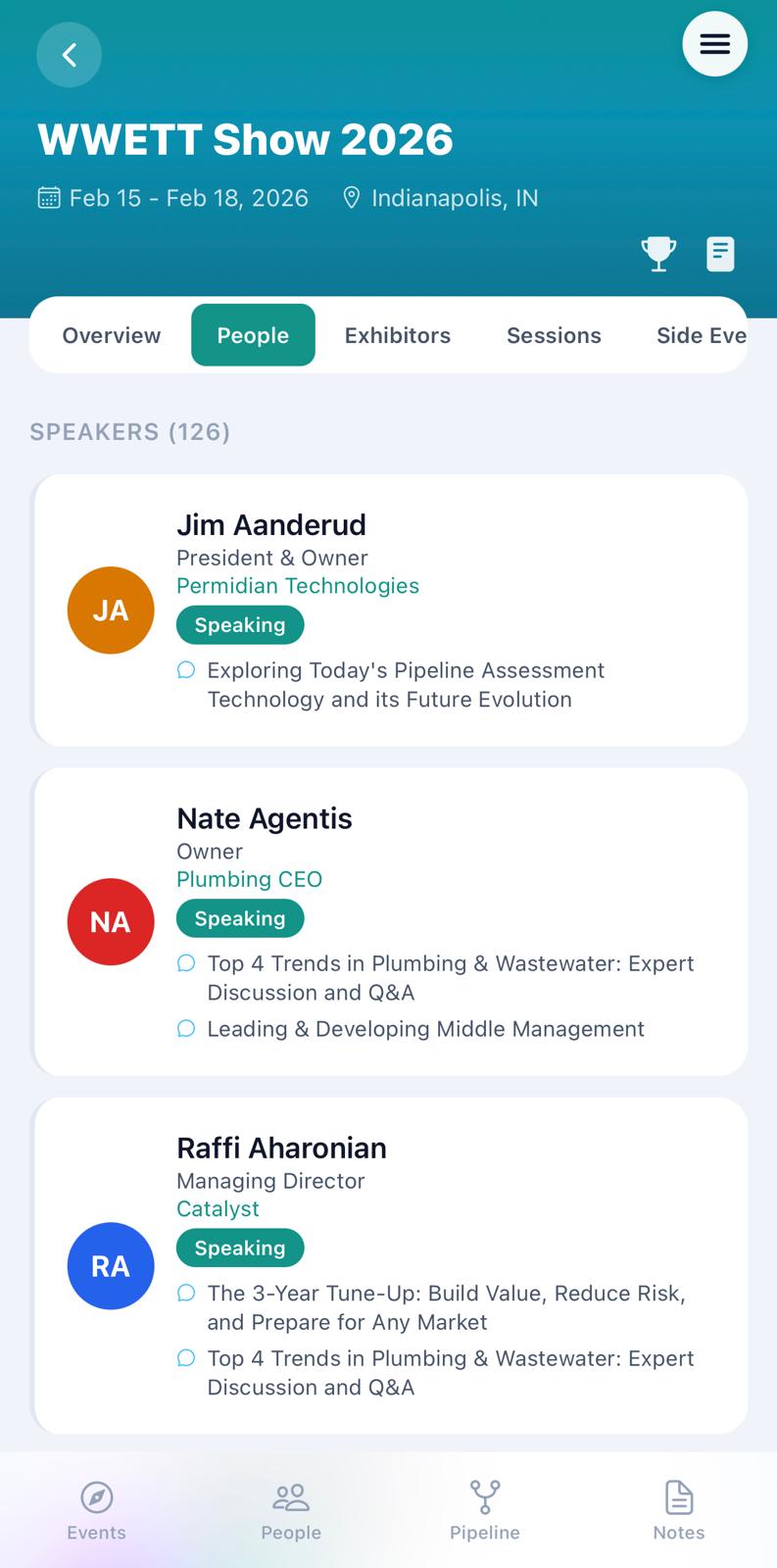
A real example: WWETT Show 2026
Indianapolis, February. 159 speakers, 535 exhibitors, 50 sessions, 14,000 people. Here is what the loop looks like on an event that actually happened.
- Track WWETT as an event, with prep steps from tracking to notes
- See which speakers and exhibitors matter for your accounts, not all 535
- Capture booth and dinner conversations while they are fresh
- Recognise who you met before, with the context from last time
- Land what was said on the account, next to the public record


What this is not.
Events are a source of context, not a separate product. Five things we will not do, and why.
-
We do not become your CRM
We feed the context graph and the account record.
-
We do not treat every badge scan as a lead
A scan without context is a name. Context is the point.
-
Speaker and leadership signals come from public event materials
Where they exist. We do not invent attendance.
-
No customer names or dollars on this page
Illustrative accounts only.
-
This is AquaIntel context, not a separate product brand
One graph. One account.
Where this sits in the loop
All solutions-
Screen
-
Monitor
- Account intel
- Minutes monitoring
- This page
-
Map the room
-
Clocks
-
Draft
-
Catch the bid
-
Fit-check
-
Screen
-
Monitor
- Account intel
- Minutes monitoring
- This page
-
Map the room
-
Clocks
-
Draft
-
Catch the bid
-
Fit-check
Questions we get on every call
WHAT YOU GET ON A CALL
Target account, upcoming panel, in-room note, one account record
A walkthrough of the loop on an illustrative utility, not a named customer. No self-serve plan.
-
The event
Where your target account’s people appear next
-
The note
What was said in the room, captured in the moment
-
The account
Where it lands, next to the public record